Sunday, 17 May 2015

Some Of My Favourite Director's At The Moment

On the 3rd of May, I will get up, grab a bite to eat, and catch a train down from Leicestershire to London so that I can visit the BFI Southbank centre, and watch the magnificent 8 1/2 -  a film by the legendary Federico Fellini, about a director who lapses into his own memories and dreams as a result of existential and professional boredom.


As far as cinema goes, it is one of the most artistically accomplished and interesting films ever made. It is among one of my favourite movies ever, and considered by many to be one of the greatest films of all-time (see BFI's Sight & Sound poll for 2012*) - so when I heard that there was a re-release of it on the big screen, I booked the tickets online almost as soon as they became available. 

*I know I mention the BFI (British Film Institute) a lot, but they are an organisation I love and thus I will likely never stop mentioning them.

It was the re-release of this film that made me ask myself the question "who are my favourite directors?" - I was thinking how Fellini's work on this movie is often regarded as one of the greatest examples of film direction in cinema, so I believe the question flowed from that. It is a question I have asked myself before, several times in fact, but one which I hadn't really paid much attention too. Mostly, I ended up with answers like "oh, well, Kubrick, probably, but I also like Scorsese blah blah blah". Ultimately, I came to the conclusion that, like so many things, the answer will likely change, so a better question to ask myself would be "what are my favourite directors as of RIGHT NOW - at this moment in time?"

So, here they are.
YASUJIRO OZU


Yasujiro Ozu was a Japanese filmmaker, born 1903, who began his career in the late 20s, carrying on into the early 60s, until his death in 1963 - on his 60th birthday. While often held in high regard as one of the greatest Japanese directors of all-time, up there with the likes of Akira Kurosawa and Kenji Mizoguchi; the man's style of film-making is remarkably different. 

Often disregarding traditional storytelling rules of cinema like the 180-degree rule; his films have become known for their individualistic and precise framing; they are often shot at low angles and with actors facing the camera directly during conversations, as opposed to the traditional over-the-shoulder shots. He is also known for barely moving his camera - while camera movement is evident in earlier work, it is less so in older work, especially in his last film An Autumn Afternoon which is completely static. 

Families and generational gaps are the central themes of his work - though his later and more renowned films such as Late Spring and Tokyo Story take a more serious approach to the themes, even his early comedy films like I Was Born, But touch upon them. 

Late Spring
What I have just told you about Ozu is really why I love him as a director - why he is a director that I always find a joy to watch. His unique way of shooting is something I find endlessly fascinating, and the core theme of family that runs throughout his movies never seems to get old, staying universally relevant precisely because each story is different, with interesting characters who are both flawed and fascinating. My favourite movie of his is Late Spring, but his final work, An Autumn Afternoon, is the one that I most connected with - in my opinion, the second best of his colour films, just behind Floating Weeds; it may have been his final work, but it is one that shows the director's boundless passion for cinema.
ANDREI TARKOVSKY


Andrei Tarkovsky was a Soviet-born Russian filmmaker, born 1932, whose career spans from the 1950s to the 1980s - essentially making him the figurehead for late Soviet cinema. Though highly-regarded in critical communities, he is perhaps not as highly regarded as earlier Soviet filmmakers like Eistenstein with the quite literally revolutionary Battleship Potemkin, and Vertov with the frantic Man with a Movie Camera. Regardless, Tarkovsky is still a giant of Russian cinema, and is responsible for some of the most emotionally-satisfying and fully-realised pieces of cinema ever made.  

Stalker
His films are often filled with long takes, showcasing some of the most beautiful and elaborate shots ever put to film, yet none are superficial. His themes are often mystical and metaphysical in nature, leaving the meaning open to interpretation, while still maintaining a level of artistic intent. Common motifs in his films include water and floating, only adding to the mysterious nature of his movies. His later films, such as The Sacrifice, may not be his best films, but are some of the best to watch if you wish to examine this director's specific style. However, Tarkovsky is working at his cinematic peak with films like Andrei Rublev and Stalker.

You could say that I am drawn to the director's surreal approach, and I am, but there is something more than that. Call me crazy, but his films always possess a transcendental level of intrigue - one which can't be easily defined, but one that I believe may be down to the fact that his films never seem to run out of ideas. They are, for me, the cinematic equivalent of meditation. Even at his grimmest, his films feel like a breath of fresh air.

My favourite movie of his is Andrei Rublev - I do believe it is also his best film, and one of the greatest films ever made. An incredibly powerful movie that may run at its own pace, but is filled to the brim with rich imagery and events that remain fascinating and awe-inspiring. I do also feel that Solaris and The Mirror are both worth mentioning, as they are both themselves cinematic feats. 

RICHARD LINKLATER


Richard Linklater is an American film-maker, born in Texas in 1960, who started off his film career as a key figure in the 90s independent cinema scene with 1991's Slacker. He has been constantly making movies since then, with his latest release Boyhood being released in 2014, after a now famous 12-year production schedule. Though he isn't held in as high regard as the aforementioned Ozu and Tarkovsky, I do believe that Linklater is one of the greatest film-makers of our generation - largely down to his ability to cinematically manipulate that most precious of things: time (which I will explore later).

His film-making approach is often grounded in his approach to realism and human emotion. More often than not, his films do not follow a standard linear plot - this is in aid to the realism, as it would appear that a linear story would give the film a sense of contrivance, and would distract from the true aims of the film - to create a realistic and compelling portrait of the characters. Referring back to his ability to manipulate time, his characters remain victims of time almost. This is remarkably evident in films like Boyhood and the Before trilogy, as we focus on how time has changed and shaped the characters and their story - however, it is also noticeable in some of his more contemporary films, like School of Rock. Jack Black's Dewey Finn IS a victim of time, in that he is stuck in a time when rock music ruled. I wish to further elaborate on this point, but that's for another blog post that I am currently writing.

He has been a favourite director of mine ever since I first saw Before Sunrise - simple and elegant in its approach, I was enamoured by the two characters and their journey through the streets of Vienna in this Rohmer-esque walkabout. The first film I saw of his was School of Rock, but this was WAY before I even knew Linklater directed it. This eventually lead me to the classic Dazed and Confused, and also lead me to some of his failures like The Newton Boys and Bad News Bears, which I do not consider his best films at all, but I do see them as stepping stones to something greater, and they all without a doubt show him as a director who loves his trade.

My favourite of his movies has to be Boyhood. Full stop. It resonated in me on an emotional level unlike any film I have ever watched - this is a film that not only encapsulates Linklater's style and quality as a director, but the dynamics of modern family life. Its soaring ambition is not only grounded in its time scale, which is impressive anyway, but its ability to cover topics of motherhood, sibling rivalry, love, friendship, modern life, politics, and even pop culture in such exquisite detail without ever seeming contrived or forced. On a personal level, it struck a chord because this film came out just as I was heading to university, and considering how this film ends, how could it not?
However, his Before trilogy will always have a great place in my heart, as some of the most thoughtful and enchanting romantic drama films ever created. I eagerly anticipate his next project That's What I'm Talking About.


Sunday, 29 March 2015

Talking 'Bout Five of My Favourite Films

This is my first post, so I'm thinking "what heck, start it straight off with a little article about my favourite movies - because people will give a shit about that!"

Over the years, there have been many films that I have considered my favourite films of all-time. Like many of these types of opinions, however, they constantly change. As one watches more and more films, you begin to discover things about cinema which you never previously knew. You begin to appreciate these films for what they are, what they say, and what they do.

Right now I would like to talk about five of my favourite films. In a year (hell, maybe in a month), my tastes will likely change once more, but I simply want to share with you my opinions, and my feelings towards some of the films which I consider my favourites.

2001: A SPACE ODYSSEY

This cinematic legend, generally considered to be the greatest science-fiction film of all-time and even one of the greatest films of all-time, is my favourite film as of RIGHT NOW. When I originally watched it (circa 2011), I honestly did not think much of it - in fact, I hated it. Though I am a Kubrick fan-boy now, I despised him when I first decided that film was something I wanted to pursue. Back when I first laid eyes upon it, I was about as bewildered by it as those apes at the beginning of the film were when that black monolith suddenly appeared in front of them, accompanied by that famous haunting score. About twelve months went by and my opinion was a solid as ever, until BFI released their decennial Greatest Films of All Time list in 2012. Curious, I perused it, and discovered that 2001 was at #6. Ahead of it were films like Citizen Kane, Vertigo, Tokyo Story, Sunrise, and The Rules of the Game - all films I, at the time, held in higher regard than 2001 (don't be mistaken, I still think those films are all masterpieces). Confused by this, I thought to myself "okay, so maybe I should give 2001 another chance". After all, I had just watched A Clockwork Orange and Full Metal Jacket for the first time and loved them, why not give Kubrick another chance?

So I watched it, and the rest, as they say, is history. Well, mostly. It was still not my favourite film of all-time (that crown went to Once Upon A Time In the West), but certainly in my top 10. I finally understood it - or at least began to. I had realised that this film was more than just a confusing sci-fi flick. It was a monster. An opera of so much ambiguity and technical marvel that it was overwhelming - a film that demanded that second watch. Emotionally, it gets under your skin, but intellectually, it begs questions which no earthly drama or comedy dare. It is ambition in its purest form. Kubrick was my hero.

And how did it become my current all-time favourite movie? In September 2014, I had begun university down in Surrey - one day, I ended up visiting London for the day, and came back as a member of the British Film Institue. One day in November, the BFI were showing 2001 at the Southbank cinema as part of their 'Days of Fear and Wonder' season. I had booked tickets in advance and I felt that it was a necessity to view it as it was meant to be viewed - in a theatre, with booming audio, and with seats crammed with people. That November day, I watched it, and left the cinema refreshed. A truly perfect experience was only disrupted by one or two 2001 newbies who walked out during the Intermission, complaining that it didn't make any sense. I felt sorry for them. They had no idea what they just watched.

RAGING BULL

As far as cinema goes, Scorsese is quite accessible and instantly recognisable. His virtuoso direction and film-making, echoing his boundless cinephilia, make his films breaths of fresh-air: intelligent and vibrant films that almost anybody can watch (well, kids might have to give some of his films a wide berth, but you get the picture). Raging Bull was not the first Scorsese film I ever saw - that was Taxi Driver, followed by Goodfellas, then King of Comedy, Cape Fear, Mean Streets, and Casino. So pretty much everything that Robert de Niro has collaborated with Scorsese in, excluding New York, New York, which I have to admit to this day I still have not seen. What put me off Raging Bull? A horrible bias towards sports movies. I never grew up in a household that was particularly crazy about films - sure, we'd watch Star Wars or Indiana Jones if it was on. You know, safe classics that everybody in the Western world has watched or at least heard of. This meant all the stereotypes towards certain movies were also locked into my brain - sports film were for sporty people, romcoms were for girls, blah, blah, blah. It was just something I had to learn to shake off.

I love Moneyball!
And I did. With Raging Bull. I got hold of a DVD copy of the film in early 2012 - this was when I decided to begin my DVD collection, so I thought even if I didn't like it, it would be a welcome addition to my at the time fledgling pile of movies - in the same way that some people have To Kill a Mockingbird or Ulysses on their bookshelf, not through wanting to read it, but to say "hey, look, I've got Ulysses." At first, I liked the film. There were Scorsese films I preferred, like Goodfellas and Taxi Driver, but I still really liked it. I had now rid myself of the stereotype I held for those kinds of movies - I ended up watching The Wrestler and Moneyball almost straight afterwards and loving them, especially Moneyball.

It did not stop there, though. Only a few months later, I decided to rewatch it simply through impulse. Though I only managed to watch half of it (I can't remember why there was an interruption), I discovered that Raging Bull was a lot more poetic and a HELL of a lot better than I first realised - I saw this film as a raw depiction of a self-destructive man. A man whose life is dictated by jealousy and raw emotion that he fails to contain in both his professional and personal life - his fight with Janiro is possibly one of the most satisfyingly shot and edited scenes in film history, and is an indication of just how powerful this film is. This psychologically-taut film found itself rocketing up towards the top of my favourite films list, now securing its place at #2. A masterclass in subjective cinema.

BOOGIE NIGHTS

It may not be a film that many would put up there with 2001 or Raging Bull - but in my complete honesty, I do not understand why not. Paul Thomas Anderson is a modern day auteur, a sultry combination of Scorsese and Altman, responsible for some of the most challenging yet ultimately rewarding movies of the late 90s and 21st century - similar to how Ebert viewed Herzog, I think Anderson is a director whose failures (I'm looking at you Inherent Vice) are spectacular in their own right. Boogie Nights, his epic drama revolving around one well-endowed young man's journey through the rise and fall of the US porn industry, is a movie that is as tragic as it is funny.

The first time I watched this movie, I fell in love with it. I had only watched one PTA film before then, and that was There Will Be Blood, a film I adore and feel is artistically more accomplished than Boogie Nights, but regardless, I love Boogie Nights more - plain and simple. The first thing I fell in love with was the soundtrack - you could consider it superficial, but I have to disagree. Remarkably timely but also aesthetically appropriate, the songs featured in the film, including '99 Luftballons' by Nina and 'Livin Thing' by ELO, are, in their own way, cheesy and quirky, mirroring the glitzy and unusual lifestyle that these people lead. Yet beneath all the gloss and nudity is a constantly moving drama filled with people that feel real - they have their ambitions, their quirks, their faults. They are not perfect human beings. We are introduced to a drama where everyone involved is desperately trying to achieve something in the life they have been dealt - and what makes this film even MORE delightful is in its nonjudgmental and polite attitude towards the industry it portrays. 


Currently, this film is #4 on my list. It's one film I probably think about more than I should do - it doesn't reach for grandiosity, but neither is it restrained. It's a phenomenally-constructed portrait of a lifestyle that many would be quick to judge. It's a movie that kicks pessimism in the shins and stands upon its quivering body like a podium - by that, I mean it is a dark movie and at times riddled with pathos, but is endlessly optimistic: even when some characters are on their decline, the film remains humorous and engaging, and after it all ends, we are back where we begin - with a big happy family who may not lead the best life, but it is a life nonetheless. 

COME & SEE

To me, there are two primary eras of Soviet cinema: there is early Soviet cinema which has become synonymous with Communist propaganda and revolutionary editing (see Sergei Eisenstein and his legendary Battleship Potemkin), and then there's post-Stalin cinema of the Soviet Union which brought forth some of the most creatively ambitious films ever made, notably the filmmaker Andrei Tarkovsky with such masterpieces as Stalker and Andrei Rublev (the latter of which still suffered from a great deal of censorship). However, one movie - directed by Elem Klimov - is both a perfect example of post-Stalin Soviet cinema, combined with the raw truthfulness showcased in early Soviet propaganda films, and then some. What is this film you ask? Well, I'll guess you'll just have to come and see...

Come & See is possibly the most unflinching, scariest, dirtiest, honest, and relentless films ever made. It's more of a psychological horror than a war movie. I came across this masterpiece while searching through Empire's 500 Greatest Films list, coming in at #60, just behind Spielberg's Close Encounters of the Third Kind and just ahead of Singer's The Usual Suspects. Having seen both these films, I went for the halfway point and, well, never returned, so to speak. Though both those films are brilliant, Come & See is on another level. That level may be a dirt-filled and blood-soaked one, but it's certainly a level. Though this film is grim beyond content, shamelessly displaying the corpses of loved ones and providing seamless shots of people being burned alive in a church, the ending is one of the most uplifting and heart-wrenching ever. Finally, we have soaked in the misery and the toil of our protagonist as he has been carried through piercing battlefields and treacherous swamps, complete with a toxic soundtrack - and when all this is over, he stands face-to-face with a picture of Adolf Hitler, rifle in hand, and shoots his anger away in an outburst of fury, accompanied by a booming classical score, as the film reverses back time until our hero is face-to-face now with the same man, but as a baby. Our main character's face, once youthful and innocent, has now become wrinkled, grey, and aged. War has changed him not only emotionally, but physically too. 

Okay, so maybe this film sounds pessimistic and a little on the harsh side. However, I can't deny that. This film takes a brutally honest vision of war and jacks it up to eleven. It makes its point. It is an immovable force, aching to show you how savage humans can be. It is my #5, purely for the experience and the complete and total honesty this film wears on its sleeve. If you want a happy film, you've taken the wrong path. And there's no going back.

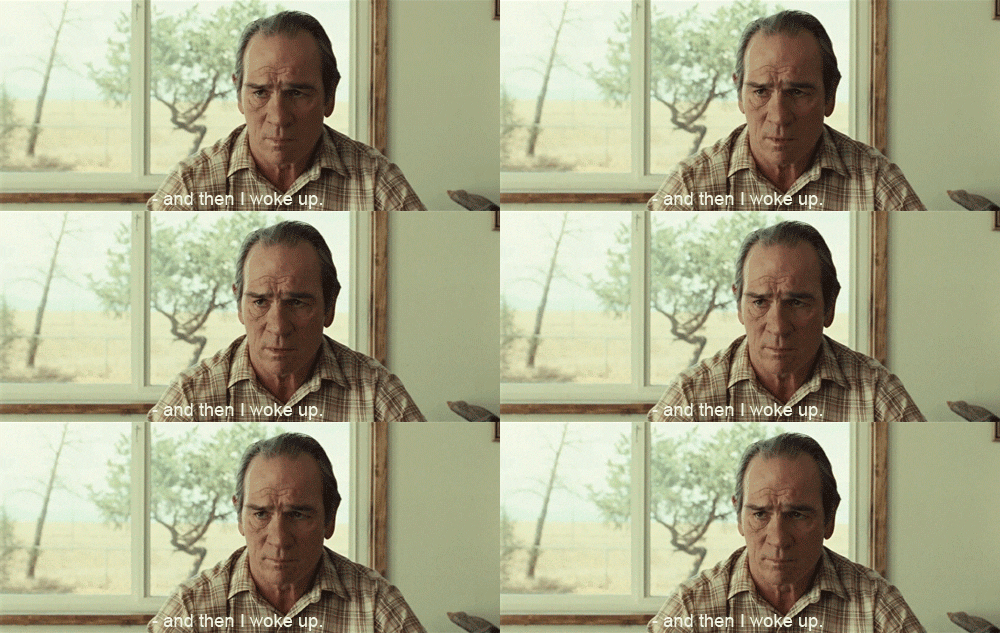
NO COUNTRY FOR OLD MEN

The Coen brothers are directors who I feel have never 'peaked', so to speak. They were at their strongest during the 90s with the classic Fargo, the hilarious The Big Lebowski, and the under-appreciated Barton Fink. It may be too early to don one of their most recent efforts Inside Llewyn Davis as a classic, but is otherwise one of the best films of 2010s (at least, so far). However, in my opinion, their greatest film (which I also consider the second greatest film of the 21st century so far) is No Country for Old Men - an outright masterpiece.

I wanted to watch this film when it came out all the way back in 2007, after I heard about it through some friends who were lucky enough to sneak into the screening. I was 11 or 12 at the time, and considering that the film is a 15 rating over here in the United Kingdom, and I was an unadventurous sort, I couldn't see it at the cinema so I waited for the DVD release. I wasn't amazingly into film at this point - it wasn't until around 2010 that I started to garner an interest - but I adored this movie even then. I remember loving it because it was this serious, thought-provoking film, yet it was violent, grim, and unforgiving. I loved it even more because of the ending - it wasn't a happy ending, nor was it amazingly satisfying, but there was something I found endlessly intriguing about it. It just seemed to shout "oh, you don't like it? Well, tough shit. This is how things go." It still is today probably up there with my favourite film endings.


It now sits comfortably at my #6 spot, after being absent from my top 50 for a good few years. Between 2008 and 2013, I didn't rewatch it. The DVD copy I had went missing, and I was so pre-occupied with work and school that I simply just forgot. I eventually got hold of a new copy and re-watched it. Since then, it has planted itself firmly in my top 25. But THEN I went to see it at a showing at the BFI Southbank, and was overwhelmed once more by just how much of a masterpiece I thought this film was - masterful storytelling, intense performances, a screenplay that's as unpredictable as it is gripping, and a constant tone of soft paranoia that is entirely justified with some of the most gritty violence ever seen in such a film. It crept up towards #6 and has stayed there ever since.